

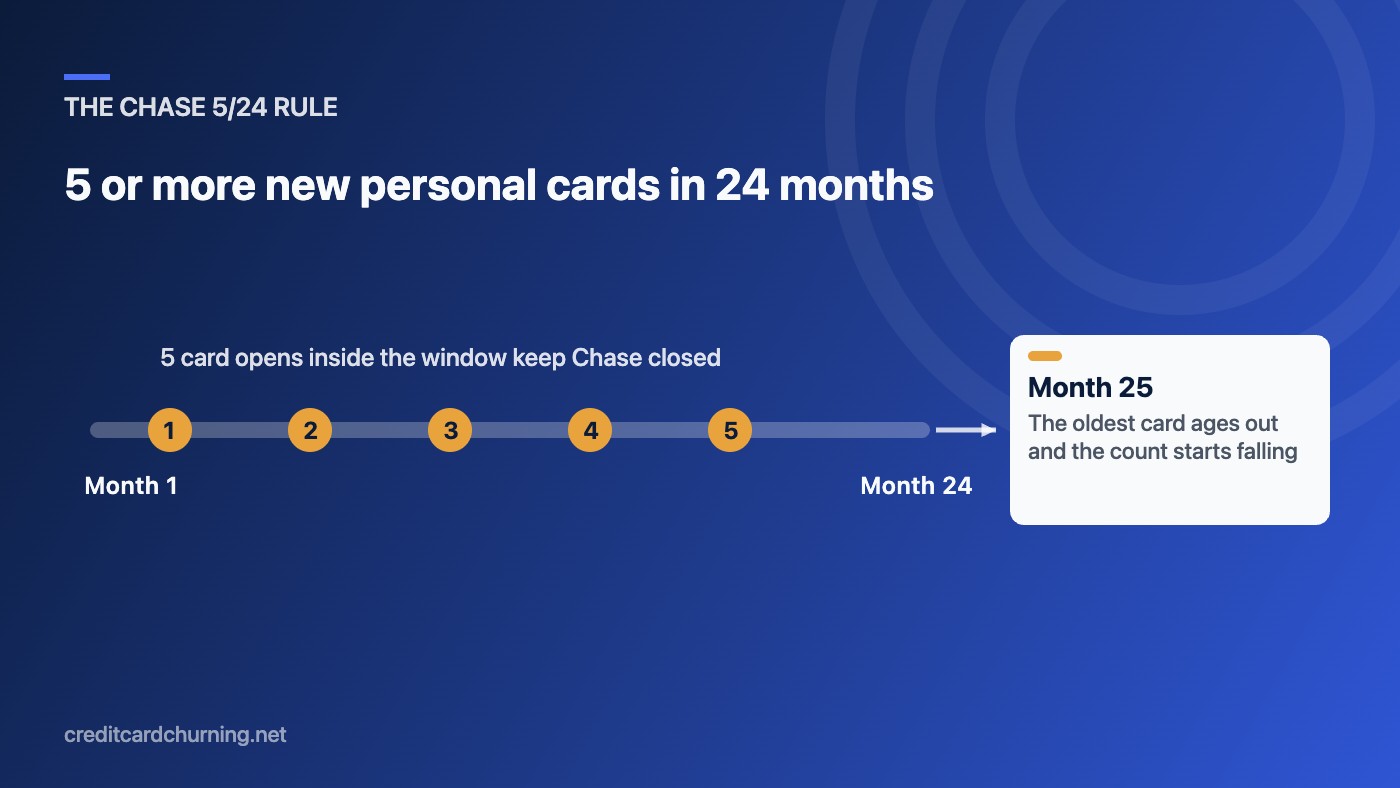
Chase declines most credit card applications once your credit reports show 5 or more new personal cards opened in the past 24 months. Business cards from most issuers never appear on personal reports, so they usually do not raise the count. Check your count and next safe date in the 5/24 calculator.
The community calls this policy the 5/24 rule. It is unwritten, it appears in no card agreement, and it shapes more credit card churning timelines than any other issuer policy.
The rule counts cards from every bank, not just Chase. Open 5 personal cards anywhere in 2 years and Chase locks you out of its best cards, including the Sapphire Preferred, Sapphire Reserve, and the Ink business line.
This guide covers how the count works, what is exempt, 3 ways to check your status, and how to order your applications so 5/24 costs you nothing.
What the 5/24 rule says
If your credit reports show 5 or more new personal credit card accounts in the past 24 months, Chase automatically declines your application for any card subject to the rule. The decline usually arrives as a letter citing “too many accounts opened recently.”
3 details matter more than anything else:
- It counts all banks. A Citi card, an Amex card, and a Capital One card each take one of your 5 slots.
- It counts openings, not inquiries. A denied application costs a hard pull but adds nothing to your count. An approval adds 1 regardless of how the bank pulled your credit.
- The window rolls monthly. Each card stops counting 25 months after its opening month, so your count drops on a schedule you can predict to the month.
How to count your 5/24 status
Advertisement
-
Pull your credit reportsUse AnnualCreditReport.com or a free service like Credit Karma.
-
List every personal card opened in 24 monthsInclude store cards and cards you have already closed.
-
Add authorized user accountsChase counts them by default, though reconsideration can remove them.
-
Skip most business cardsChase, Amex, Citi, and Wells Fargo business lines do not report to personal credit.
Pull a free credit report from AnnualCreditReport.com or use a free monitoring service. Then list every personal credit card account with an opening date inside the past 24 months. Count cards you have since closed; closing a card never removes it from the count.
Add authorized user accounts opened in that window. They appear on your report, and Chase’s automated systems count them. You can get them disregarded by calling reconsideration, but plan as if they count.
Leave out business cards from issuers that do not report business accounts to personal credit bureaus. That covers Chase, Amex, Citi, Bank of America, Barclays, US Bank, and Wells Fargo. Discover business cards report to personal credit, so they count. Capital One says its Spark Cash Plus, Venture X Business and Venture Business cards do not report to personal credit while in good standing; check any other Capital One business card before you apply. For Bank of America’s own approval limits, see the Bank of America credit card rules.
The result is your X/24 number. At 4/24 you have 1 slot left. At 5/24 you are locked out until your oldest counted card ages past 24 months.
What counts and what does not
- Personal cards from any bank
- Store and retail cards
- Authorized user accounts
- Cards opened and already closed
- Most small business cards
- Hard inquiries without approval
- Loans, mortgages, auto financing
- Cards opened 25 or more months ago
| Account type | Counts against 5/24 |
|---|---|
| Personal credit card, any bank | Yes |
| Store or retail card | Yes |
| Authorized user account | Yes, removable by reconsideration |
| Closed personal card opened within 24 months | Yes |
| Business card from Chase, Amex, Citi, BofA, Barclays, US Bank, Wells Fargo | No |
| Business card from Discover, or a Capital One business card that reports personally | Yes (Capital One says Spark Cash Plus, Venture X Business and Venture Business do not report while in good standing) |
| Hard inquiry from a denied application | No |
| Auto loan, mortgage, student loan | No |
The business card exemption is the single most useful fact in this table. It means you can keep earning signup bonuses from business cards without spending 5/24 slots. The details live in our guide to business cards and 5/24.
Do Chase business cards count against 5/24?
They do not add to your count, but they are subject to it. Chase Ink cards do not report to your personal credit reports, so an approved Ink leaves your 5/24 number where it was. Chase still checks 5/24 when you apply, so you need to be under 5/24 to be approved. Since September 2026, some sole-proprietor Ink applications have been reported to stop at 3/24 (Doctor of Credit, September 17, 2026; Frequent Miler, September 23, 2026).
| Business card | Adds to your 5/24 count? | Needs you under 5/24? |
|---|---|---|
| Chase Ink cards | No | Yes; 3/24 reported for some sole proprietors |
| Chase co-branded business cards (United, Southwest, IHG, Marriott, Hyatt) | No | Yes |
| Amex business cards | No | No; Amex does not use 5/24 |
| Capital One Spark Cash Plus, Venture X Business | No, while in good standing | No |
| Capital One Spark Cash, Spark Cash Select | Yes; they report to personal credit | No |
A worked example: at 4/24 you open an Ink Business Preferred and stay at 4/24, so a Sapphire Preferred is still open to you next. Open a personal card instead and you reach 5/24, and Chase’s personal cards close until the oldest account ages out. Capital One’s reporting list is from its business card guide (September 3, 2026).
A product change opens no new account, so it never adds to 5/24; Chase says an upgrade usually involves no hard inquiry either. Pre-approved offers from Chase are a soft check until you apply. A hard inquiry stays on your report for 2 years; see how long hard inquiries stay on your credit report.
Which cards 5/24 blocks
The rule applies to nearly every card Chase issues, both personal and business. That includes the full Sapphire, Freedom, Slate, and Ink lines plus co-branded cards from United, Southwest, Marriott, Hyatt, IHG, British Airways, Aer Lingus, Iberia, Amazon, and Instacart.
Reports of exceptions have surfaced over the years for a handful of co-branded products, but they come and go without notice. The safe assumption in 2026: every Chase card checks your count at application.
Remember the asymmetry for business cards. Chase Ink cards require you to be under 5/24 at application (since about September 16, 2026, applicants also report a 3/24 cutoff on some sole-proprietor Ink applications, which Chase has not confirmed), but once approved they never add to your count. An Ink approval is free in 5/24 terms.
3 ways to check your status
1. Count manually. The 4 steps above, using any free credit report. Most accurate, since you see exactly what Chase sees.
2. Use a tracking spreadsheet. If you churn regularly, log every approval date in a churning tracker spreadsheet and your current count is always one glance away, along with the month each slot frees up.
3. Use Experian’s app. The free Experian app lists accounts by opening date, which makes the 24-month math quick. It misses accounts that only report to TransUnion or Equifax, which is rare for credit cards but possible.
Application order strategy
5/24 punishes the wrong application order more than it punishes volume. 2 principles cover most situations:
Chase first. Other major issuers will approve you while over 5/24. Chase will not approve you at all. So new churners should spend their first 4 slots on Chase cards before touching other banks. A common opening sequence: Sapphire Preferred, then an Ink business card (no slot used), then Freedom Flex, then a United or Hyatt card, and only then cards from Amex, Citi, and Capital One.
Business cards in between. Between Chase applications, business cards from Amex and other exempt issuers keep bonuses flowing without moving your count. Capital One has its own application rules and some of its business cards report personally, so slot those with care.
Velocity still matters within Chase. Applicant reports point to an unofficial 2/30 limit, meaning at most 2 approvals per rolling 30 days, and 1 for business cards. Spacing Chase applications 3 months apart keeps you clear of velocity flags and looks better to underwriters.
Opening this many accounts has a credit score cost, but it is smaller and shorter-lived than most people expect. The mechanics are covered in does churning hurt your credit score.
Where the rule stands in 2026
Chase rewrote 2 other rules in June 2025, retiring the 48-month wait between Sapphire bonuses and the one-Sapphire-card limit. Its Sapphire pages now say the bonus may not be available if you previously held that card or received its new cardmember bonus, which works as a per-card lifetime limit. That change set off speculation that 5/24 would follow, and since late 2025 forums have carried scattered reports of approvals at 5/24 or higher.
The volume of those reports stays small against the steady stream of “too many accounts opened recently” denials. Until Chase says otherwise or approvals over the limit become routine, treat 5/24 as fully active. Planning around a rule that later disappears costs you nothing; planning on its absence can waste a hard pull and a 30-day wait.
Update, 21 October 2026. 5/24 still blocks most applicants: a February 2026 forum thread titled “Chase’s 5/24 is Gone” rests on a single Sapphire Preferred approval at about 7/24, and One Mile at a Time wrote on 17 October 2026 that the rule “does seem to still be fully enforced” for most people. Separately, Doctor of Credit (17 September 2026) and Frequent Miler (23 September 2026) reported Chase declining some sole-proprietor business card applications at 3 or more new cards in 24 months; Chase has not confirmed it, and an Ink Business Preferred approval at 4/24 was also reported.
If you are over 5/24 right now
Being at 5/24 or higher is a waiting game with 3 ways to shorten it.
Do the falloff math. Your count drops the month after a card crosses 24 months of age. List your 5 newest personal cards by opening date and you know the exact month each slot returns. If you sit at 5/24 with the oldest counted card opened in August 2024, you are back to 4/24 in September 2026.
Remove authorized user accounts. If an AU account is one of your 5, ask the primary cardholder to remove you, then dispute the account off your credit reports with the bureaus. Even without removal, Chase reconsideration agents will often manually approve an application when the only over-limit account is an AU card. Say it plainly on the call: the account is an authorized user account, you do not control it, and you would like it disregarded.
Watch for targeted offers. In-branch pre-approvals and some targeted mail offers with no 5/24 language have historically gone through for over-limit applicants. These reports are inconsistent, so treat a targeted offer as a chance worth taking, never as a plan.
While you wait, business cards from exempt issuers keep your earning alive. An Amex business card approval at 6/24 changes nothing about your Chase timeline.
A worked example
Here is a 24-month plan for someone starting at 0/24 with a 740 score who wants Chase cards first and steady bonuses throughout.
| Month | Application | 5/24 count after |
|---|---|---|
| 1 | Chase Sapphire Preferred | 1/24 |
| 4 | Chase Ink Business Cash | 1/24, business card adds nothing |
| 7 | Chase Freedom Flex | 2/24 |
| 10 | Chase World of Hyatt | 3/24 |
| 13 | Amex business Gold | 3/24, exempt |
| 16 | Chase United Explorer | 4/24 |
| 19 | Amex personal card | 5/24, Chase done for now |
| 22 | Citi or Capital One card | 6/24 |
By month 25 the Sapphire Preferred ages out and the count starts falling, opening the next Chase window. The pattern holds: Chase while under the limit, exempt business cards in the gaps, everyone else after.
The reconsideration call, scripted
When a Chase application pends or declines and you believe you are under 5/24, the reconsideration line is where it gets fixed. Keep the call short and stick to facts. State your count plainly: the report shows 6 new accounts, 2 are authorized user cards you do not control, and you would like them disregarded. Agents handle this request daily and approve it more often than not.
For velocity flags, the useful facts are your income, your on-time history with Chase, and a willingness to move credit line from an existing Chase card to fund the new approval, which lets Chase approve the card without raising your total credit line. Arguing that 5/24 is unfair does not help, and neither does describing a bonus-driven application pattern. Keep the call to about 5 minutes and write down the date and the agent’s confirmation for the tracker.
See where this rule lands in the 6 issuer rules ranked by breadth.
Related guides
- Business cards and 5/24: the loophole that powers most churning careers
- The Chase 2/30 rule: the speed limit behind 5/24
- The Chase reconsideration line: numbers, scripts, and what actually reverses denials
FAQ
Does the 5/24 rule apply to business cards?
Yes at application time, no in the count. You need to be under 5/24 to be approved for a Chase business card, but Chase Ink cards and most other business cards do not report to your personal credit, so they do not add to your 5/24 number.
Do authorized user accounts count against 5/24?
Yes, by default. Chase counts authorized user accounts opened in the past 24 months. If an authorized user account pushes you over the limit, call the reconsideration line and ask Chase to disregard it. This works in most reported cases.
Is the 5/24 rule still active in 2026?
Yes. Chase replaced the Sapphire 48-month bonus rule and the one-Sapphire-card limit in June 2025 with per-card bonus terms, and a few applicants have reported approvals while over 5/24 since late 2025, but the rule still blocks the large majority of over-limit applications.
When does a card fall off my 5/24 count?
25 months after the month it was opened. A card opened in March 2024 stops counting in April 2026. The clock runs from the account opening date on your credit report, never from when you got the bonus or closed the card.
Does checking my own credit hurt my 5/24 status?
No. Checking your own credit is a soft inquiry. 5/24 counts opened accounts, never inquiries, so even a denied application with a hard pull adds nothing to your count.
Next up in issuer rules: the Amex once per lifetime rule and the Citi 48 month rule, the 2 policies that decide when you can repeat a bonus.
Does a product change count toward 5/24?
No. A product change keeps the same account open, so nothing new appears on your report. Chase says an upgrade usually involves no hard inquiry.
Which business cards count toward 5/24?
Only those that report to your personal credit reports. Capital One says its Spark Cash and Spark Cash Select do, while Spark Cash Plus and Venture X Business do not while in good standing. Chase, Amex and most other business cards stay off personal reports.
Last reviewed October 2026. We verify every rule, ratio, and figure against issuer terms and current reporting, and date each one. See our editorial standards for how we research and correct guides.
We re-check these guides as issuer rules and award charts change. 2 ways to follow along, no account needed.