

The Chase trifecta is 3 cards doing 1 job: a Sapphire, a Freedom Flex, and a Freedom Unlimited pooling every point they earn into a single transferable balance, paying 1.5x to 8x on every dollar. The Sapphire choice is the permanent one, so make it carefully. Sequence yours in the application order planner.
The Chase trifecta is 3 cards doing 1 job: a Sapphire, a Freedom Flex, and a Freedom Unlimited, pooling every point they earn into a single transferable balance. Run correctly it pays 1.5x to 8x on every dollar you spend, at an annual fee as low as $95 for the whole stack. Confirm the current fee and any welcome offer at Chase.
The Sapphire Reserve reimburses the fee every four years, which makes Global Entry, which includes TSA PreCheck, close to free while you hold the card.
It is the default endgame for Ultimate Rewards earners, the system most churning careers settle into between application cycles, and the reason a drawer full of downgraded Chase cards keeps earning its keep for decades.
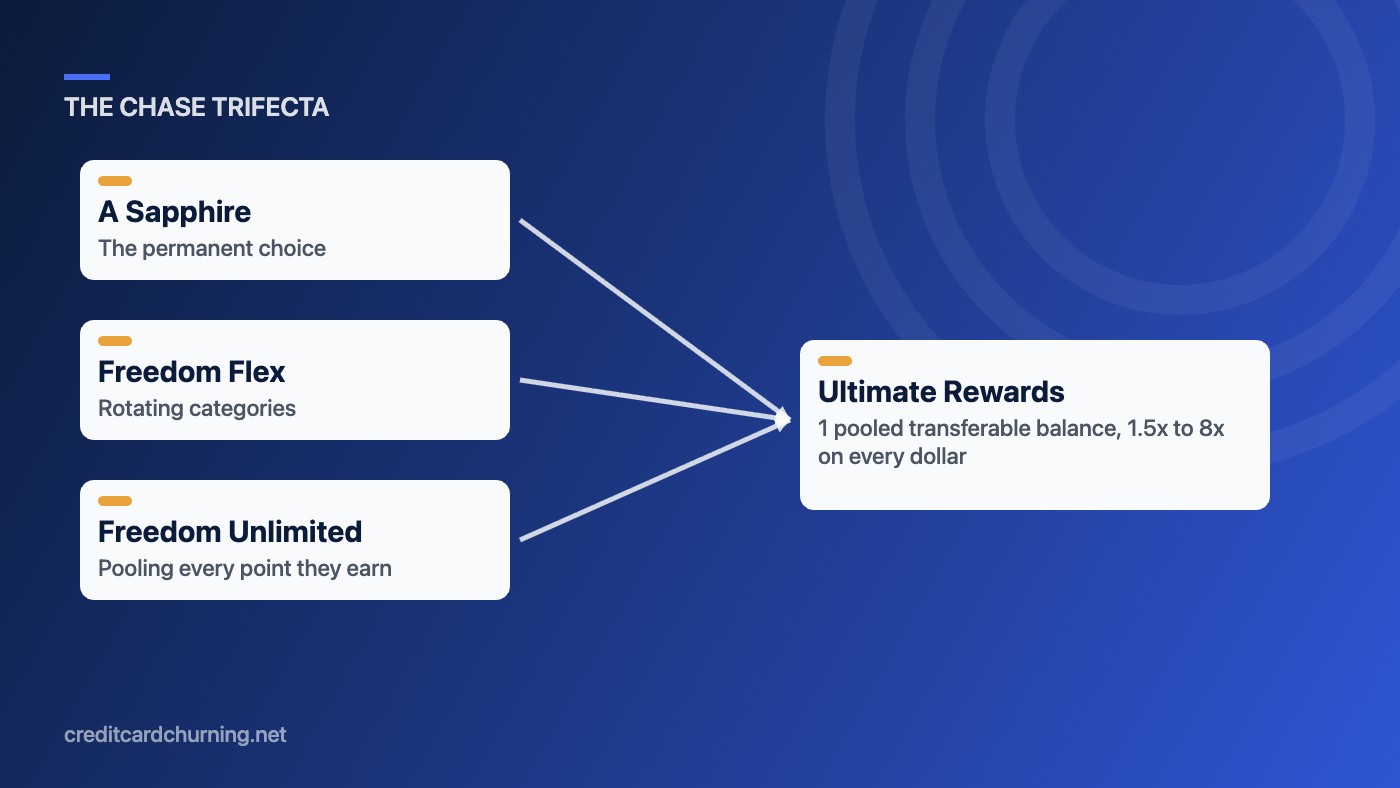
The 3 pieces and their rates
- Freedom Flex catches the quarters5 percent rotating categories, up to $1,500 per quarter.
- Freedom Unlimited catches everything else1.5 percent floor on every uncategorized dollar.
- The Sapphire catches dining and travelAnd holds the partner-transfer keys for the whole stack.
- Pool and transferAll points combine on the Sapphire and move 1:1 to 14 travel partners.
| Card | Fee | Earning, as of June 2026 |
|---|---|---|
| Freedom Flex | $0 | 5% rotating quarterly categories on up to $1,500 per quarter, 5% Chase Travel, 3% dining and drugstores, 1% elsewhere |
| Freedom Unlimited | $0 | 1.5% on everything, 3% dining and drugstores, 5% Chase Travel |
| Sapphire Preferred | $95 | 5x Chase Travel, 3x dining, select streaming and online groceries, plus 2026 additions like gas and vacation rentals, 2x other travel, 1x elsewhere |
| Sapphire Reserve | $795 | 8x Chase Travel, 4x flights and hotels booked direct, 3x dining, 1x elsewhere, plus the credit package from the 2025 refresh |
The assignments follow from the table: groceries and the quarter’s category go on the Flex, dining and travel on the Sapphire, and every uncategorized dollar on the Unlimited’s 1.5 percent floor. 3 cards, no dollar earning less than 1.5.
Pooling: the mechanic that makes it work
Advertisement
Freedom cards by themselves are cash back cards. Their points redeem at a fixed cent each and stop there. The trifecta exists because Chase lets you move points freely between your own Ultimate Rewards cards, and a premium card on the account upgrades everything it touches.
Pool the Flex’s 5 percent quarter onto a Sapphire and those points stop being worth 5 cents on the dollar and start being worth whatever a transfer partner pays. A mid-tier Hyatt night under the 2026 chart turns roughly $200 of would-be cash back into a $400 room. The same mechanic works across household: Sapphire holders can combine points with one member of their household.
Preferred or Reserve
Both Sapphires reach identical transfer partners, so the choice is a fee-against-perks calculation, and the 2025 Reserve refresh sharpened it. The Reserve’s $795 fee buys 8x in the portal, 4x direct flights and hotels, lounge access, and a stack of statement credits that, used naturally, offset most of the fee. Used unnaturally, they are coupons that talked you into a $795 card.
The honest test: list the credits you would have spent money on anyway, subtract, and compare the remainder against $95. Most people churn through a Preferred first, experience their actual travel pattern, and upgrade only when the credits map onto money already leaving their account. The detailed fee logic mirrors the retention math: pay for cards that pay you back.
Building it the churner way
Nobody should apply for 3 cards at face value when 2 of them carry welcome bonuses and 1 can be created by downgrade. The standard build:
1. Sapphire first, under 5/24. The Sapphire bonus, historically 60,000 points and up, is among the best first bonuses in the game, and 5/24 math says Chase cards come early.
2. Freedoms with bonuses, spaced out. Each Freedom has carried a $200-equivalent bonus for years. They are 5/24 slots, so slot them between bigger applications.
3. Or mint a Freedom by downgrade. A Sapphire past its first year converts to a Freedom on request: no application, no inquiry, no 5/24 slot, account age preserved. Long-run churners accumulate Freedoms this way every Sapphire cycle, which is half the argument in downgrading credit cards.
A patient builder collects the full stack plus 2 to 3 welcome bonuses inside 18 months, all while staying eligible for the rest of the Chase lineup.
What it produces in a year
Take a $40,000 spending year: $8,000 dining, $6,000 groceries, $6,000 travel, $6,000 quarterly-category overlap, $14,000 everything else. Routed correctly through a Preferred trifecta, that is roughly 84,000 points: 24,000 from dining at 3x, 24,000 from the Flex quarters at 5x, 12,000-plus from travel, and 21,000 from the floor at 1.5x.
At cash value, $840. Transferred well, 84,000 points is several mid-tier Hyatt nights that would have cost $1,500-plus at cash rates, or most of 2 transatlantic business class seats through a Flying Blue promo. That gap between $840 and $1,800-plus, repeated every year at a $95 fee, is the whole argument for the structure.
Amex runs the same play with different pieces, covered in the Amex trifecta guide, and plenty of households run both stacks side by side.
A trifecta year, quarter by quarter
The system runs on a light quarterly rhythm, and seeing a year of it makes the maintenance cost concrete.
January: activate the Flex’s Q1 category in the app, 30 seconds, and point the matching spending at it; grocery quarters are the famous ones, worth the full 7,500 points to a household that grocery-shops anyway. Check that autopay survived the new year on all 3 cards.
April: Q2 activation. This is also the standard annual-fee month check for a May-fee Sapphire: the retention call, the keep-or-downgrade decision, and for Preferred holders, the anniversary points hitting the account.
July: Q3 activation, and the mid-year points review: what did the first half produce, and does the balance justify planning a transfer redemption for the fall booking season? This is when the household checks award space for next spring’s trip, because international award calendars open 11 months out.
October: Q4 activation, the heavy quarter, since holiday categories like PayPal and wholesale clubs cover December spending at 5x. Year-end total for a typical household: 80,000-plus earned points, perhaps 1 transfer bonus caught, 2 hours of total administration. The system’s entire running cost is 4 activations, 1 fee decision, and the discipline of pulling the right card out of the wallet.
Configuration mistakes that cost real points
Letting Freedom points sit as cash back. The most common error: redeeming Flex earnings at 1 cent while holding a Sapphire that would have made them transferable. Points should consolidate to the premium card before any redemption decision, every time.
Forgetting activation. The 5x quarters require a quarterly click, and an unactivated quarter pays 1 percent. The fix is mechanical: calendar reminders on January 1, April 1, July 1, October 1, or activation during the monthly spreadsheet review.
Putting dining on the Unlimited. Small leak, real money: the Unlimited’s 3 percent at restaurants loses to a Reserve’s 3x only in transferable form; for Preferred holders both pay 3, but consolidation rules still favor earning on the card whose points you will pool anyway. The wallet rule that prevents all such leaks: each card gets a physical or digital label with its job, and the job list is 3 lines long.
Carrying the structure without the travel. A household that redeems everything for cash back should not pay any Sapphire fee; 2 Freedoms and a no-fee 1.5 percent card replicate the earning without the $95. The trifecta earns its name only when transfers happen.
The business-side variant
Sole proprietors run a 4th card into the stack or swap the anchor entirely: the Ink Business Preferred carries the same transfer access as a Sapphire at the same $95, earns 3x on the first $150,000 of travel, shipping, internet, and advertising, and its points pool with the personal cards. The full quartet, Sapphire plus 2 Freedoms plus an Ink, is the standard endgame for churners with business spending, and the Ink’s bonus history, frequently 90,000 to 100,000 points, makes it a recurring stop in the flowchart sequence rather than a one-time setup piece. The 5/24 asymmetry covered in business cards and 5/24 applies in full: the Ink requires being under the limit to get, and never counts against it afterward.
Quick reference
The setup: 1 Sapphire or Ink Preferred for transfers, Freedom Flex for quarters, Freedom Unlimited for the floor. The routing: quarters to the Flex, dining and travel to the Sapphire, everything else to the Unlimited. The maintenance: 4 quarterly activations, 1 annual fee decision, points pooled before every redemption. The rule that protects everything: a transfer-capable card stays open at all times.
The benchmark numbers for a sanity check each December: a $40,000 routed year should produce 80,000-plus points before bonuses; a Preferred-based stack should cost $95 and feel free after 1 good transfer; and any year where everything redeemed at 1 cent was a year the structure ran below its design, worth 10 minutes of asking why.
The Sapphire in this setup moonlights as a protection card: the coverage details are in credit card travel insurance.
Related guides
- The Amex trifecta: Gold, Platinum, and the free card that completes them
- Chase transfer partners: all 14 programs and the ones worth your points
- Delta Companion Certificate: 2026 Rules and How to Use It
FAQ
What 3 cards make up the Chase trifecta?
A Sapphire card, either Preferred or Reserve, plus the Freedom Flex and Freedom Unlimited. The Freedoms earn at no annual fee; the Sapphire converts everything into transferable points. An Ink Business Preferred can stand in for the Sapphire in business versions of the setup.
Why do the Freedom cards need a Sapphire at all?
Freedom cards alone redeem points at fixed cash-back value with no partner access. Pooled onto a Sapphire or Ink Preferred, those same points transfer to Hyatt, United, Flying Blue, and 11 other programs, all at 1:1 except Hyatt from a Sapphire Preferred or Ink Preferred (4:3 since October 1, 2026), where redemptions of 2 cents per point and up are routine.
Should the trifecta use the Preferred or the Reserve?
Run the fee math. The Preferred costs $95 and covers the essentials: transfers, 3x dining, travel protections. The Reserve costs $795, earns 8x in Chase Travel and 4x on direct flights and hotels, and pays back through credits and lounge access. Frequent travelers who use the credits come out ahead on the Reserve; everyone else starts with the Preferred.
What order should I get the trifecta cards in?
Sapphire first, while you are under 5/24, because it carries the big welcome bonus. Freedom cards second, often one of each over the following year. Many churners never apply for a Freedom at all: a downgraded old Sapphire becomes a Freedom and joins the stack with its account age intact.
How many points does a trifecta produce in a year?
A household putting $40,000 of mixed spending through the stack typically clears 70,000 to 90,000 points from earning alone, before any welcome bonus or referral. At a conservative 1.5 cents per transferred point, that is $1,000-plus of travel per year from ordinary spending.
Not sure which cards to stack? See the best cards by category for the top pick in each kind of spending.
Last reviewed October 2026. We verify every rule, ratio, and figure against issuer terms and current reporting, and date each one. See our editorial standards for how we research and correct guides.
We re-check these guides as issuer rules and award charts change. 2 ways to follow along, no account needed.