

The Amex trifecta is the highest-earning 3 card stack in the points world: Gold at 4x on food, Platinum at 5x on flights, Blue Business Plus at 2x on everything else, all pooling into one Membership Rewards balance. The family rule makes the order permanent, so sequence deliberately in the application order planner.
The Amex trifecta is the highest-earning 3 card stack in the points world: Gold at 4x on food, Platinum at 5x on flights, Blue Business Plus at 2x on everything else, all pooling into one Membership Rewards balance that reaches 20 transfer partners.
The Platinum and other premium cards rebate the application fee, so it is worth checking which credit cards cover TSA PreCheck or Global Entry before you pay out of pocket.
It is also the most expensive stack, with $1,220 in gross annual fees as of the 2025 refresh pricing, which makes it the setup where honest math matters most. This guide covers the pieces, the fee logic, and the build order that keeps every welcome bonus on the table. The foundations live in the churning guide.
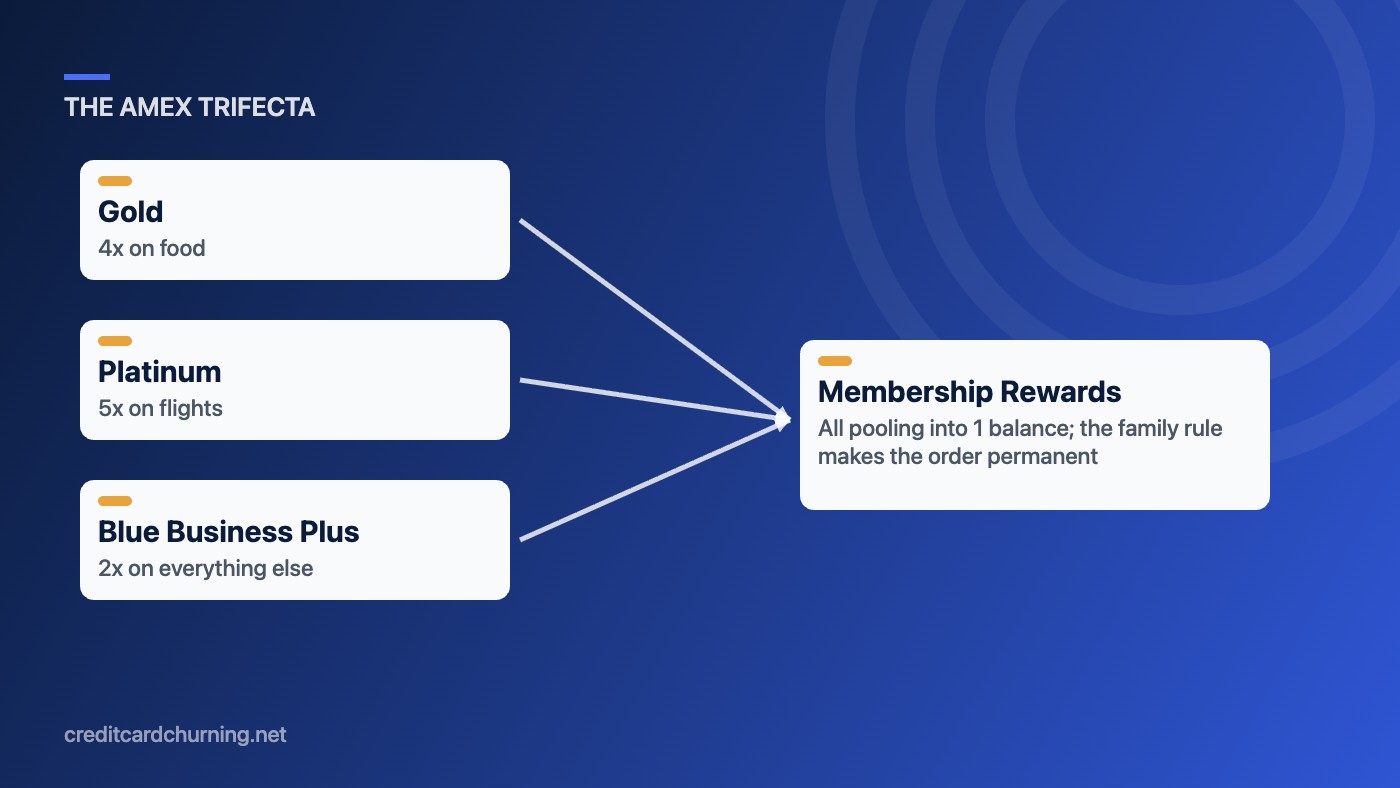
The 3 pieces and what they earn
- Gold catches food4x at restaurants and US supermarkets, the heaviest categories.
- Platinum catches flights5x on airfare booked direct or through Amex Travel.
- Blue Business Plus catches the rest2x on everything else up to $50,000 a year, no annual fee.
- One Membership Rewards balanceEverything pools and transfers to 20 programs.
| Card | Fee, June 2026 | Role |
|---|---|---|
| Gold | $325 | 4x at restaurants worldwide, on up to $50,000 a year, and 4x at US supermarkets on up to $25,000 a year; dining and grocery credits offset part of the fee |
| Platinum | $895 | 5x on flights booked with airlines or through Amex Travel, on up to $500,000 a year; lounge access and the credit stack from the 2025 refresh |
| Blue Business Plus | $0 | 2x on all purchases up to $50,000 a year, then 1x; the floor for everything uncategorized |
Routing is mechanical: restaurants and supermarkets on Gold, airfare on Platinum, literally everything else on the BBP. The caps are generous enough that a typical household never thinks about them; the $50,000 BBP cap is the one heavy spenders eventually meet.
The quiet hero: Blue Business Plus
Advertisement
Gold and Platinum share a weakness: 1x on anything outside their categories. For most budgets, uncategorized spending is the single biggest bucket, which means the glamorous cards earn their worst rate on the most dollars.
The Blue Business Plus exists to fix exactly that. 2x on everything, no fee, no categories to think about. It is a business card, which stops some people who should not be stopped: a sole proprietorship with real side income qualifies, the same one covered in business cards and 5/24, and the BBP itself stays off your personal reports.
Without the BBP, the so-called trifecta is 2 expensive cards and a hole. With it, no dollar in your life earns less than 2 points.
The fee math
$1,220 gross is real money, and credits are the industry’s favorite way to make it look smaller. The honest procedure, the same one from the retention guide: count only credits that replace spending you already had, subtract them, and judge what remains.
A frequent flyer who eats out, uses the airline and hotel credits naturally, and values lounges can push the net cost of the stack under $300 while earning 4x and 5x on their heaviest categories. A homebody who has to invent uses for each credit is paying most of $1,220 for points that 2 no-fee cards would mostly match.
The middle path is popular for a reason: Gold plus BBP at $325 gross captures food at 4x and a 2x floor, deferring the Platinum until flights and lounges are a regular part of the year.
Build order and the lifetime rule
The once per lifetime rule shapes the build more than any earning rate. Welcome offers on these cards run 60,000 to 175,000 points depending on the channel and the cycle, and each is generally available once. 3 ordering principles:
Climb, never descend. Family rules can block bonuses for people who held a higher card first. Green or Gold before Platinum keeps every rung’s bonus alive.
Wait for strong offers. The pop-up makes checking free, and offer history on these cards is public knowledge. Taking a Platinum bonus at 80,000 when 150,000 appears twice a year is the most expensive impatience in churning.
The BBP bonus is a bonus. It has carried modest offers, sometimes none. Its job is the 2x floor; any welcome offer is gravy, so it slots in whenever convenient.
Business versions of Gold and Platinum double the available bonuses for sole proprietors, with their own family considerations on the way up.
Against the Chase trifecta
| Amex stack | Chase stack | |
|---|---|---|
| Gross fees | $1,220 | $95 to $795 |
| Food earning | 4x | 3x dining, 5x rotating quarters |
| Flight earning | 5x | 2x to 4x, 8x portal on Reserve |
| Floor | 2x via BBP | 1.5x via Freedom Unlimited |
| Partners | 20, international depth | 14, Hyatt anchor |
The Chase version wins on cost and on Hyatt; the Amex version wins on raw earning and partner depth. Churners usually end up with both balances anyway, because the bonuses along the way dwarf any single year of earning rates, and 2 currencies mean 2 sets of transfer bonuses and sweet spots to shop between.
A month of routing, line by line
Here is a $3,400 spending month flowing through the stack, the way it looks once the habit settles.
Groceries, $720 across 9 supermarket runs: Gold, 2,880 points. Restaurants and takeout, $410: Gold again, 1,640 points. 2 flights for a fall trip, $640 booked directly with the airline: Platinum, 3,200 points. Then the long tail, $1,630 of utilities, insurance, gas, hardware store, streaming, a vet bill: all Blue Business Plus, 3,260 points. Month total: 10,980 points on spending that a 2 percent cash card would have paid $68 for, roughly $165 to $220 of travel value at typical transfer redemptions.
The routing errors worth catching in month 1: gas is not a Gold category, US supermarkets excludes Target and Walmart by merchant coding, and airfare through an online travel agency other than Amex Travel earns 1x on Platinum, not 5x. The fixes are habits, not effort: fuel and big-box runs live on the BBP, flights book direct, and the wallet’s 3 cards each do exactly 1 job.
The credit ledger, honestly kept
The fee math section above says count only credits that replace real spending. Here is what that ledger looks like for a household that flies 4 times a year and eats out weekly.
On the Gold: the monthly dining credit at partners the household already used covers most of its face value, call it $100 of the $120 real. On the Platinum: the airline incidental credit covers checked bags and seat fees the trips were paying anyway, the hotel credit gets used on 1 prepaid stay, the streaming and rideshare credits cover existing subscriptions, but the wellness and retail credits go half-used, and they exist to pad the printed credit total. Honest annual total: roughly $700 of the $1,000-plus printed credit value.
Against $1,220 of gross fees, the net cost lands near $500 for this household, which their 130,000 annual points, worth $1,900-plus transferred well, comfortably justify. A household that flies twice and dislikes the credit-tracking chore lands closer to $400 of real credit value, and their honest answer is the Gold-plus-BBP middle path. The arithmetic is personal, which is the point of doing it on paper instead of trusting either the marketing or the cynics.
Working the upgrade ladder
The stack interacts with Amex’s upgrade machinery in a way worth planning. A Green or Gold cardholder receives periodic targeted offers, 25,000 to 40,000 points to upgrade to the next card, and accepting one adds points without consuming the upgraded card’s welcome offer eligibility under the lifetime rule, since upgrade bonuses are a separate offer class. The patient line through the lineup: earn the Green or Gold welcome offer, hold and spend normally, accept an upgrade offer in year 2, and bank the difference, having collected 2 bonuses where an impatient applicant collected 1.
Retention offers stack on the same accounts annually, the script works especially well on Platinum, and the combination of welcome offer, upgrade bonus, and retention points can pull 200,000-plus points from a single card line over 3 years. That long arc, more than any single rate, is why the Amex stack rewards holders who think in years.
Quick reference
The setup: Gold for food at 4x, Platinum for flights at 5x, Blue Business Plus for everything else at 2x, 1 pooled Membership Rewards balance. The fee posture: $1,220 gross, honest credit accounting decides the net, and Gold plus BBP is the respectable middle path. The build: climb the ladder low to high, wait for strong offers, let the pop-up answer eligibility for free.
The routing traps to recite until habitual: Target and Walmart are not supermarkets to Amex, gas belongs on the BBP, and airfare earns 5x only booked direct or through Amex Travel. 3 sentences of merchant coding knowledge protect more points per year than most category tweaks earn.
Related guides
- The Chase trifecta: 3 cards, 1 balance, and the math that makes it work
- Amex transfer partners: all 20 programs, ratios, and the June 2026 changes
- Delta Companion Certificate: 2026 Rules and How to Use It
FAQ
What 3 cards make up the Amex trifecta?
The Gold for dining and US supermarkets at 4x, the Platinum for flights at 5x, and the Blue Business Plus for 2x on everything else. All 3 earn Membership Rewards into one pooled balance once linked; since October 2026 each new card opens its own Rewards Account until you link it under Manage Connections. Swapping the Green or business versions in and out produces the same structure at different fee levels.
Why is the Blue Business Plus in the trifecta?
Because it fixes the stack’s floor. Gold and Platinum earn 1x on uncategorized spending, among the worst rates anywhere. The BBP earns 2x on everything up to $50,000 a year with no annual fee, doubling the floor for free. Sole proprietors qualify for it like any business card.
How much are the Amex trifecta annual fees?
The Gold runs $325 and the Platinum $895 as of the 2025 refresh; the Blue Business Plus is $0. The gross fee of $1,220 is the headline number, and the credits on the Gold and Platinum are the offset. Whether those credits map to your real spending decides the whole setup.
Is the Amex trifecta better than the Chase trifecta?
They suit different lives. Amex pays more on food and flights and reaches 20 transfer partners; Chase costs less, includes the 5 percent quarterly card, and its partner list leans domestic with Hyatt as the anchor. Heavy diners and flyers lean Amex. Many households run both.
Can I build the Amex trifecta and still earn welcome bonuses?
Yes, and order matters because of the once per lifetime rule. The standard build runs low to high, Green or Gold before Platinum, so each card’s bonus stays available when you reach it. Upgrade offers along the way add points without burning eligibility.
Building a stack around where you spend? Compare picks in the best cards by category hub, including the best cards for groceries.
Last reviewed October 2026. We verify every rule, ratio, and figure against issuer terms and current reporting, and date each one. See our editorial standards for how we research and correct guides.
We re-check these guides as issuer rules and award charts change. 2 ways to follow along, no account needed.