

Amex pop-up jail is when American Express shows a pop-up saying you are not eligible for the welcome offer on every card you try, including cards you have never held. 2026 reports put most stays at 6 months to a year, and the check runs before any credit pull, so testing costs nothing. Check your dates first in the bonus eligibility checker.
Jail is the profile-level cousin of the once per lifetime rule. The lifetime rule blocks repeat bonuses on specific cards; jail blocks all bonuses because Amex’s models scored your relationship as unprofitable. This guide covers the trigger patterns in the data points, the free way to test your status, and the documented road out. Foundations live in the churning guide. How the subreddit works is in our guide to r/churning.
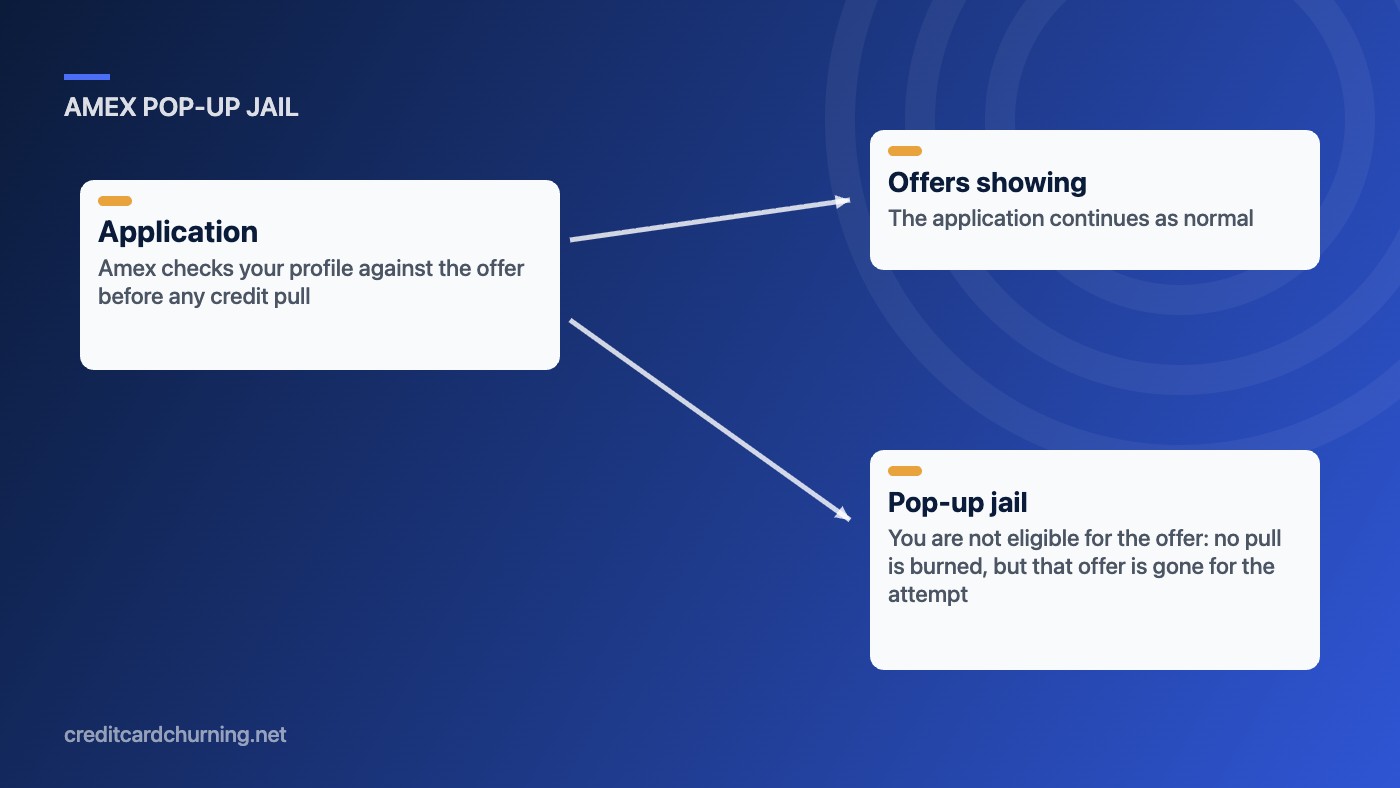
What jail is and is not
The mechanism rides on Amex’s pre-submission eligibility check. Every application runs your profile against the offer before any credit pull, and the engine returns 1 of 2 outcomes: the offer stands, or the pop-up appears. Jail is the state where the second outcome becomes universal across cards.
3 boundaries define it. Jail is about welcome offers only; approvals themselves usually remain available, and the pop-up explicitly offers to continue without the bonus. It is profile-level, which is what distinguishes it from card-level lifetime blocks: pop-ups on 2 or 3 never-held cards is the diagnostic signature. And it is invisible to phone agents, who can neither see the decision nor appeal it, because the engine answers to behavior data, and no agent can override it.
The state also decays. Unlike the lifetime rule’s 7 year horizon, jail re-evaluates at every application, and the same profile that pops today can clear in 90 days with nothing changed except the spending pattern on existing cards.
What puts people in
Advertisement
- Several Amex cards opened quickly
- Spend stops dead after each bonus
- Cards canceled inside year 1
- No charge card relationship
- Bonus-only transaction patterns
- Steady organic spend on kept cards
- An account through 2-plus annual fees
- Varied merchants, recurring charges
- 60 to 120 quiet days
- Holding a Gold or Platinum long term
Nobody outside Amex knows the model, but a decade of self-reports draws a consistent silhouette. The jailed profile opened several Amex cards in a compressed stretch, spent exactly to each minimum requirement and then went quiet, canceled cards inside their first year, and holds no long-term anchor with the issuer. Each behavior alone is unremarkable; the combination is a textbook bonus-and-run pattern, and the model treats it as one.
2 amplifiers show up repeatedly. Heavy reliance on employee-card and retention tricks to juice spend reads worse than organic transactions. And NLL-offer chasing during jail, applying repeatedly through targeted links, appears to extend rather than shorten sentences for some reporters, consistent with every application being a fresh behavioral data point.
What does not appear to matter much: credit score, income, or 5/24-style new-account counts at other issuers. Jail is about your Amex relationship specifically, which is also why the exit runs through that relationship.
What 2026 reports add: triggers, business jail and length
| Source and date | What it reports |
|---|---|
| myFICO forum, April 16, 2026 | Pop-ups on 2 business applications after closing a Business Platinum at 1 year, with 0 new personal accounts in 24 months |
| Same thread, April 25, 2026 | Jail after accepting several retention and upgrade offers |
| Same thread, April 29, 2026 | 6 months to a year as the usual length |
| Upgraded Points, October 9, 2026 | An Amex rep pointed to a large number of canceled cards; the rep suggested applying by phone, with no outcome reported |
2 things follow. Business and personal applications can land in jail separately, so a clean personal profile does not guarantee clean business offers. And the stays reported in 2026 run longer than the 60 to 120 days older reports describe, so plan on 6 months before your first serious probe.
Testing your status for free
-
Pick the card you actually want nextA strong current offer, family rules checked.
-
Fill the application completelyThe pop-up only fires on a complete, submitted form.
-
Read the resultNo pop-up means you are out of jail; close or continue as planned.
-
If jailed, close and wait 30 daysNo pull happened. Keep spending normally and probe again.
The pop-up’s one mercy is that it fires before any hard inquiry, which turns status-checking into a free monthly routine. Amex’s own card pages say you can find out whether you are approved with no impact to your credit score (Gold card page, checked October 22, 2026). Pick a card you genuinely want next, confirm its family rules in the lifetime guide, fill the application completely, and submit. No pop-up means you are clear, and you can proceed or close the window with the knowledge banked. Pop-up means jail continues; close, lose nothing, recheck in 30 days.
2 disciplines keep the probe clean. Use a card whose offer you would actually accept, because a clear result on a card you then abandon wastes the good roll. And do not probe weekly; the reports suggesting applications themselves feed the model argue for patience between checks.
The road out
The documented exits are unglamorous and consistent: become, for a few months, the cardholder Amex’s model wants. Concretely, from the release-side reports: run real and varied spending through whichever Amex cards you keep, including small recurring charges that post monthly; hold at least 1 card through an annual fee instead of churning out; stop canceling anything for a while; and wait 60 to 120 days before re-probing.
A retention offer accepted and honored seems to help some profiles, plausibly because accepting a retention offer is the literal opposite of bonus-and-run. What has near-zero documented success: calling, complaining, applying repeatedly, or routing applications through different channels hoping for a different engine. It is the same engine everywhere.
Staying out in the first place
Jail avoidance is cheaper than jail exit, and the prevention list doubles as good Amex strategy anyway. Keep 1 anchor card long term, a Gold or a BBP that earns its keep in the trifecta regardless. Let real spending touch every card monthly rather than going dark after bonuses. Space Amex applications the way you space everything else, quarterly beats monthly. And exit cards by downgrade where paths exist, holding through at least 1 fee cycle first.
The underlying principle reads like the retention guide because it is the same principle: issuers pay bonuses to acquire relationships, and the accounts that keep paying are the ones that look like relationships. Churners who give Amex a profitable-looking core almost never report the pop-up; churners who strip-mine the lineup almost always eventually do.
A jail sentence, reconstructed
A composite from the data point threads, because the shape repeats. Year 1: a churner takes the Gold, the Platinum, and 2 Delta cards inside 14 months, each spent exactly to requirement, 2 canceled at the first fee. Month 16: the Business Gold application pops, surprising, since he never held it. Months 16 to 18: 4 more probes across the lineup, all popping. Diagnosis confirmed: jail.
The exit, months 18 to 22: he keeps the Platinum through its second fee after a 55,000 point retention offer, moves his groceries and 3 subscriptions onto the Gold, cancels nothing, and stops probing for 90 days. Month 22: the Business Gold application runs clean, approves, and the 150,000 point offer posts. Total cost of jail: roughly a year of missed bonuses, against perhaps 30 minutes of behavior planning that would have prevented it.
The reconstruction also shows why jail data is messy: his release coincided with a retention acceptance, organic spend, and the passage of time, and no one can say which mattered. The threads are full of single-variable theories; the honest summary is that all the release-side behaviors point the same direction, so do all of them.
Jail against the other Amex gates
Amex eligibility has 3 layers, and confusing them wastes probes. The lifetime rule is per card: a pop-up on a card you bonused in 2021 is that rule working as designed, no diagnosis needed. Family rules are per lineup: a pop-up on the Business Gold after holding Business Platinum may be family language, checkable in the offer terms. Jail is the residual: pop-ups on cards with no personal history and no family conflict.
The diagnostic order, cheapest first: read the terms of the card that popped, check your own history in the tracker against the lifetime and family rules, and only then probe a second, unrelated, never-held card. 2 unexplained pop-ups is the confirmation. This matters because the cures differ: lifetime blocks dissolve only with years, family blocks with climbing the lineup, jail with behavior, and applying the wrong cure to the wrong block produces the threads this guide was distilled from.
A final calibration note: a single pop-up is not jail. Amex shows targeted ineligibility for dozens of mundane reasons, and the lifetime rule produces pop-ups by design. Jail is a pattern, diagnosed across multiple never-held cards, and the diagnosis matters because the cure is months of behavior. Date your probes in the tracker, change what the release reports say to change, and let the engine re-decide on its own schedule.
Status as of October 2026: the pop-up system remains active, Amex still publishes nothing about jail, and 2026 reports describe longer stays than earlier years. This page updates as the data points move.
Corrections and fresh jail data points, especially dated release reports, are welcome through the contact page; this niche stays accurate only because people share outcomes.
Date checked October 22, 2026.
Related guides
- The Amex once per lifetime rule: what it blocks and what gets around it
- The 6 issuer rules that block the most applications, ranked
- Shutdown risk: when an issuer closes every account
FAQ
What is Amex pop-up jail?
The community name for a state where American Express shows you the welcome-offer ineligibility pop-up on every application, including for cards you have never held. The lifetime rule blocks 1 card; pop-up jail blocks your whole profile, because Amex has scored you as unlikely to be a profitable cardholder.
How do I know if I am in pop-up jail?
Test it. Fill out an application for a card you have never held and see whether the pop-up appears. The check is free: the pop-up fires before any hard pull, and closing the window costs nothing. One pop-up on one card might be that card’s family rules; pop-ups on multiple never-held cards is jail.
How long does Amex pop-up jail last?
2026 reports put most stays at 6 months to a year (myFICO, April 2026). Older reports cluster at 60 to 120 days for people who changed the underlying behavior: real spending on kept cards and no new cancellations. Amex publishes no sentence length.
Does pop-up jail affect cards I already have?
No. Jail gates new welcome offers, never existing accounts. Your current cards, points, and benefits continue unchanged, and using them normally, especially with steady organic spend, is the main documented path out.
Can I call Amex to get out of pop-up jail?
Phone agents cannot see or override the pop-up decision, and most will not acknowledge the mechanism beyond reading the offer terms. The eligibility engine answers only one input: time multiplied by changed behavior. Calls are free to make and have produced essentially zero documented releases.
What triggers Amex pop-up jail?
Reports point to a pattern: many bonuses with little spending afterward, cards canceled soon after the first fee, and several accepted retention or upgrade offers. Amex has never published its criteria.
Is Amex business pop-up jail separate from personal?
It can be. A 2026 myFICO report describes business pop-ups for someone with no new personal accounts in 24 months, after closing a Business Platinum at 1 year. Test business and personal cards separately.
Does the back button trick get around Amex pop-up jail?
We found no 2026 report of a reliable workaround. The pop-up comes from Amex’s profile check, and the documented exit is months of normal spending without cancellations.
Last reviewed October 2026. We verify every rule, ratio, and figure against issuer terms and current reporting, and date each one. See our editorial standards for how we research and correct guides.
We re-check these guides as issuer rules and award charts change. 2 ways to follow along, no account needed.