

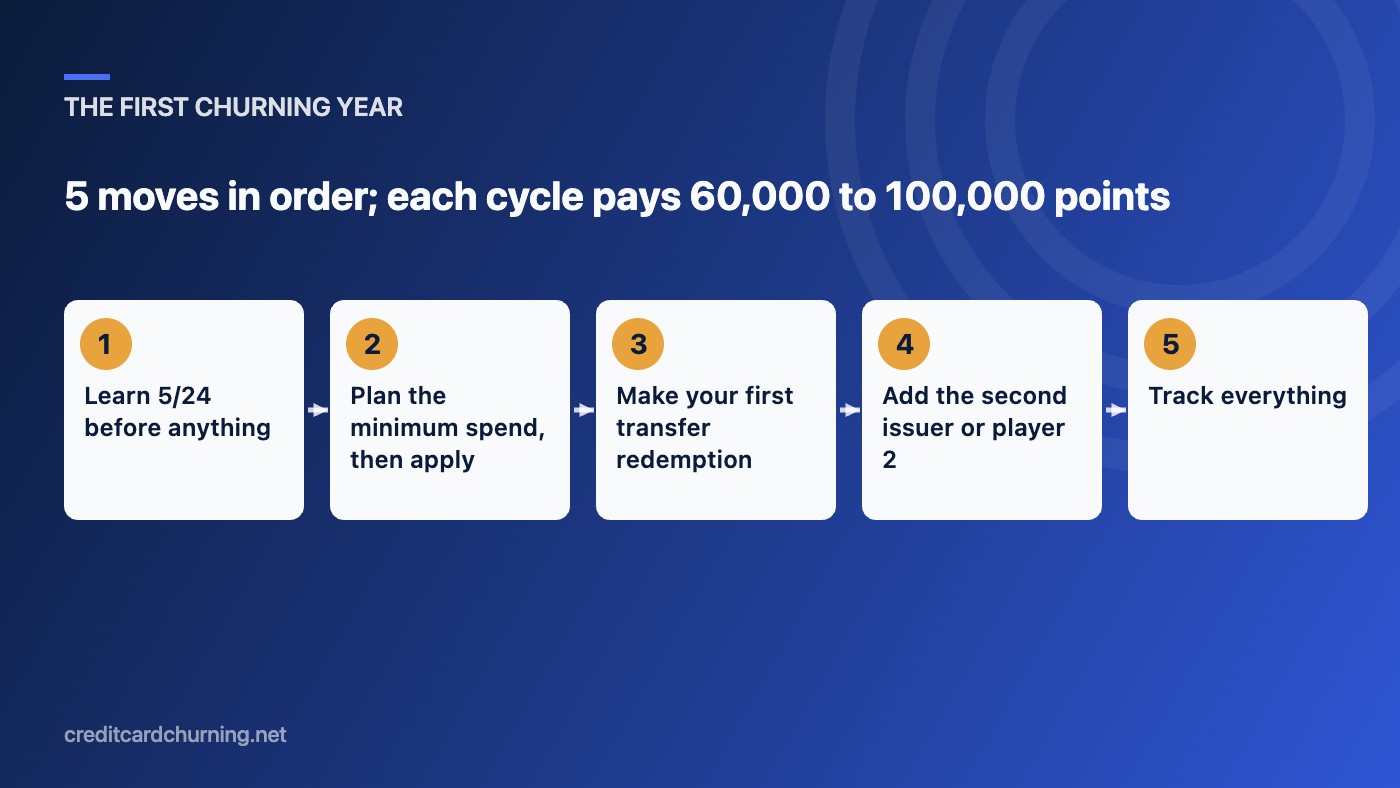
The order for year 1: learn the Chase 5/24 rule before any application, plan the minimum spend before you apply, make your first transfer redemption instead of taking cash, then add the second issuer or player 2, and track every date from day 1. Each move below quotes the guide that covers it. Start by checking your count in the 5/24 calculator.
The first churning year fails from sequence errors more than from bad cards: applications in the wrong order, spend deadlines discovered late, points earned and then spent badly. This post puts the site’s own starting sequence in 1 place, 5 moves in the order the complete guide and start here teach them, each quoting its source guide. Each cycle, run correctly, pays 60,000 to 100,000 points, worth $1,000 and up when redeemed through travel partners.
1. Learn 5/24 before anything
Start here because it cannot be undone: the Chase 5/24 rule is the one rule that sets the order of every card application you make. 5 or more new personal cards from any issuer in 24 months blocks most Chase approvals, so the cards you open first decide which doors stay open. Before your first application, know your count and what it will be after each planned card. The 5/24 guide covers counting and exemptions, and the 5/24 calculator turns your card dates into a next safe date. Chase also caps you at 2 personal approvals in 30 days under the Chase 2/30 rule.
2. Plan the minimum spend, then apply
Advertisement
The bonus only pays if the spend clears on time: earn the bonus without wasting a dollar by planning your required spend and deadline before the application, not after the card arrives. A requirement of $3,000, $4,000, sometimes $15,000 within a set window has to fit your real budget, or the annual fee buys nothing. The minimum spend guide lists the honest techniques, and the minimum spend planner maps the months before you commit. Whether credit card rewards are taxable depends on whether you spent money to earn them.
3. Make your first transfer redemption
The step that separates churning from cash back: see where transferable points go, issuer by issuer, before you pick a card, then send your first real balance to a partner instead of redeeming for cash. The difference is the whole margin: cycles pay $1,000 and up when redeemed through travel partners, far less when points die as statement credits. The transfer partners index shows every issuer’s outlets, and the points value finder prices your redemption in cents per point.
4. Add the second issuer or player 2
Once the first cycle completes, widen the base. The single biggest lever in churning is having a partner who churns too: 2 people mean 2 credit profiles, 2 sets of welcome bonuses, 2 separate 5/24 counts, and referral points passed back and forth. Solo churners widen by adding the second issuer instead, on the order the rules allow. The two-player mode guide covers the couple version, and the application order planner sequences the next 3 cards either way.
5. Track everything
Every expensive churning mistake is a forgotten date wearing a costume: the missed spend deadline, the 5/24 count remembered wrong, the annual fee with no reminder attached. A tracking spreadsheet takes 20 minutes to build, 2 minutes a month to maintain, and it decides the profit. Build it in month 1, not after the first mistake. The spreadsheet guide has the exact columns, and the issuer rules tracker holds the rule dates worth copying into it.
The risk paragraph
The sequence assumes the rules hold, and they move: the issuer rules tracker carries a last-verified date on every row for that reason. It also assumes spend you would do anyway. A bonus paid for with interest or an unpaid balance is a loss, and no move above is worth carrying debt. Verify the current rows before each application, and re-run your count after every approval. Sequence quoted from the linked guides as of July 2026.
Related guides
- Positioning flights: when the extra hop is worth it
- Credit card referral bonuses: the 2-player loop and the 1099 that follows it
- The churning spreadsheet: every column, formula, and date that matters
FAQ
Where should a first-year churner start?
With the Chase 5/24 rule, before any application: it is the one rule that sets the order of every card application you make, because 5 new personal cards anywhere lock you out at Chase. The 5/24 calculator shows your count and next safe date.
How many points does a churning cycle pay?
The complete guide’s number: each cycle pays 60,000 to 100,000 points, worth $1,000 and up when redeemed through travel partners. The first cycle usually takes a few months from approval to redemption.
Do I need a partner to make this work?
No, but it is the single biggest lever: 2 people mean 2 credit profiles, 2 sets of welcome bonuses, and 2 separate 5/24 counts. The two-player mode guide covers the mechanics as a couple.
Last reviewed October 2026. We verify every rule, ratio, and figure against issuer terms and current reporting, and date each one. See our editorial standards for how we research and correct guides.
We re-check these guides as issuer rules and award charts change. 2 ways to follow along, no account needed.